What is a Mainframe Computer? Complete Guide for Students
Published: 18 Jan 2026
What is Mainframe Computer?
Mainframe computers are massive, high-performance systems designed for handling enormous data volumes reliably. If you’re wondering what is mainframe computer, it is a powerful machine used to process and manage billions of transactions daily. They power critical operations in banks, airlines, and governments. This guide explains what is mainframe computer in simple, student-friendly language with detailed information.
Introduction to Mainframe Computer
A mainframe computer is a large-scale machine built for enterprise-level computing, far beyond regular PCs. To describe mainframe computer: It’s like a supercomputer for businesses, running thousands of programs at once with near-perfect uptime. Originating in the 1950s, modern versions like IBM z17 (2025) integrate AI accelerators and support hybrid cloud setups.
Key traits include extreme reliability (99.999% uptime), massive I/O capacity, and virtualization for multiple OS like z/OS or Linux.
Mainframe Computer System Architecture
The mainframe computer system features a Central Processing Complex (CPC) with:
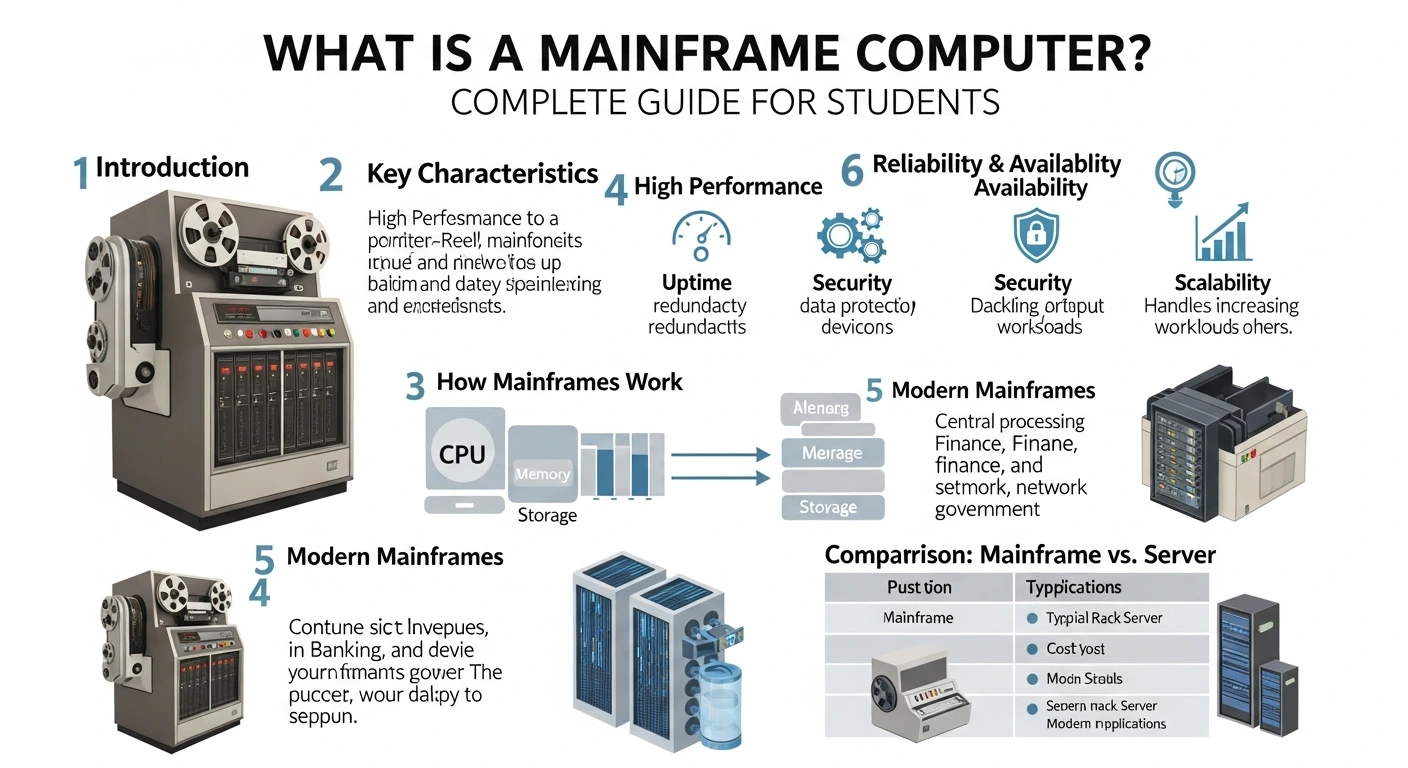
- CPUs: Central Processors (CP), Integrated Facility for Linux (IFL), and specialty engines like SAP for I/O.
- Memory: Up to terabytes of RAM with hot-swappable modules.
- Channels: Thousands of I/O channels (e.g., FICON) for peripherals, offloading CPU work.
- Storage: Petabytes via SSDs, tapes; supports encryption hardware.
Redundancy everywhere—duplicate power, cooling—ensures no single failure stops it. Virtualization via LPARs/PR/SM runs isolated partitions seamlessly.
Features of Mainframe Computers
Mainframes stand out with:
- High Throughput: 1 trillion transactions/day, measured in MIPS (millions instructions/second).
- Security: Built-in crypto processors detect threats via AI/ML; execution integrity retries instructions twice.
- Scalability: Add capacity on-demand without downtime.
- Backward Compatibility: Runs 50+ year-old code alongside modern apps.
- Efficiency: Handles OLTP and batch jobs better than server farms.
Mainframe and cloud computing hybrids let them burst to AWS/Azure for analytics while keeping core secure.
Advantages Over Other Systems
Mainframe computer price? Entry models ~$1M+, but longevity cuts costs—leasing from $50K/month.
Applications and Real-World Use
Explain mainframe computer uses: What’s a mainframe computer for?
- Finance: JPMorgan processes trades/ATMs.
- Airlines: Global bookings (e.g., 68% production workloads).
- Government: Census, tax systems.
- Retail: Peak sales like Black Friday.
In 2026, mainframe computer systems evolve with Telum II processors for AI in Asia’s industries.
Why Mainframes Matter for Students
Perfect for IT/Computer Science courses—learn COBOL, z/OS for high-paying jobs. They underpin daily tech like mobile banking. Future: Quantum-safe crypto positions them for 2030.
Frequently Asked Questions (FAQs)
A mainframe computer is a giant, reliable machine that processes massive data for big organizations, like banks handling millions of transactions daily.
Mainframes support thousands of users with 99.999% uptime and huge storage, while PCs serve individuals with limited capacity.
Mainframes handle secure core tasks, connecting to clouds like AWS for flexible scaling and analytics without compromising reliability.
Prices start at $1 million for basic models, with leasing options around $50K/month; long-term efficiency lowers total costs
They offer unmatched security, speed for high-volume tasks, and backward compatibility—powering 68% of global IT workloads

- Be Respectful
- Stay Relevant
- Stay Positive
- True Feedback
- Encourage Discussion
- Avoid Spamming
- No Fake News
- Don't Copy-Paste
- No Personal Attacks
- Be Respectful
- Stay Relevant
- Stay Positive
- True Feedback
- Encourage Discussion
- Avoid Spamming
- No Fake News
- Don't Copy-Paste
- No Personal Attacks
